

In the coming months, we will begin to see hard data assessing the nature and degree of democratic backsliding in the United States. Organizations such as Freedom House and Varieties of Democracy typically release their annual reports in February and March, and those findings are likely to be rattling!
In the meantime, there is already some important empirical work worth our attention. One especially striking analysis comes in a recent article from John Burn-Murdoch, the chief data reporter at the Financial Times. He examines not just whether democratic backsliding is occurring in the United States, but the pace at which it is unfolding. His conclusion is stark: democratic erosion during Donald Trump’s second term is occurring faster than in any other contemporary case on record.
Yes—faster than Hungary, Venezuela, Russia, or Turkey. Burn-Murdoch writes,
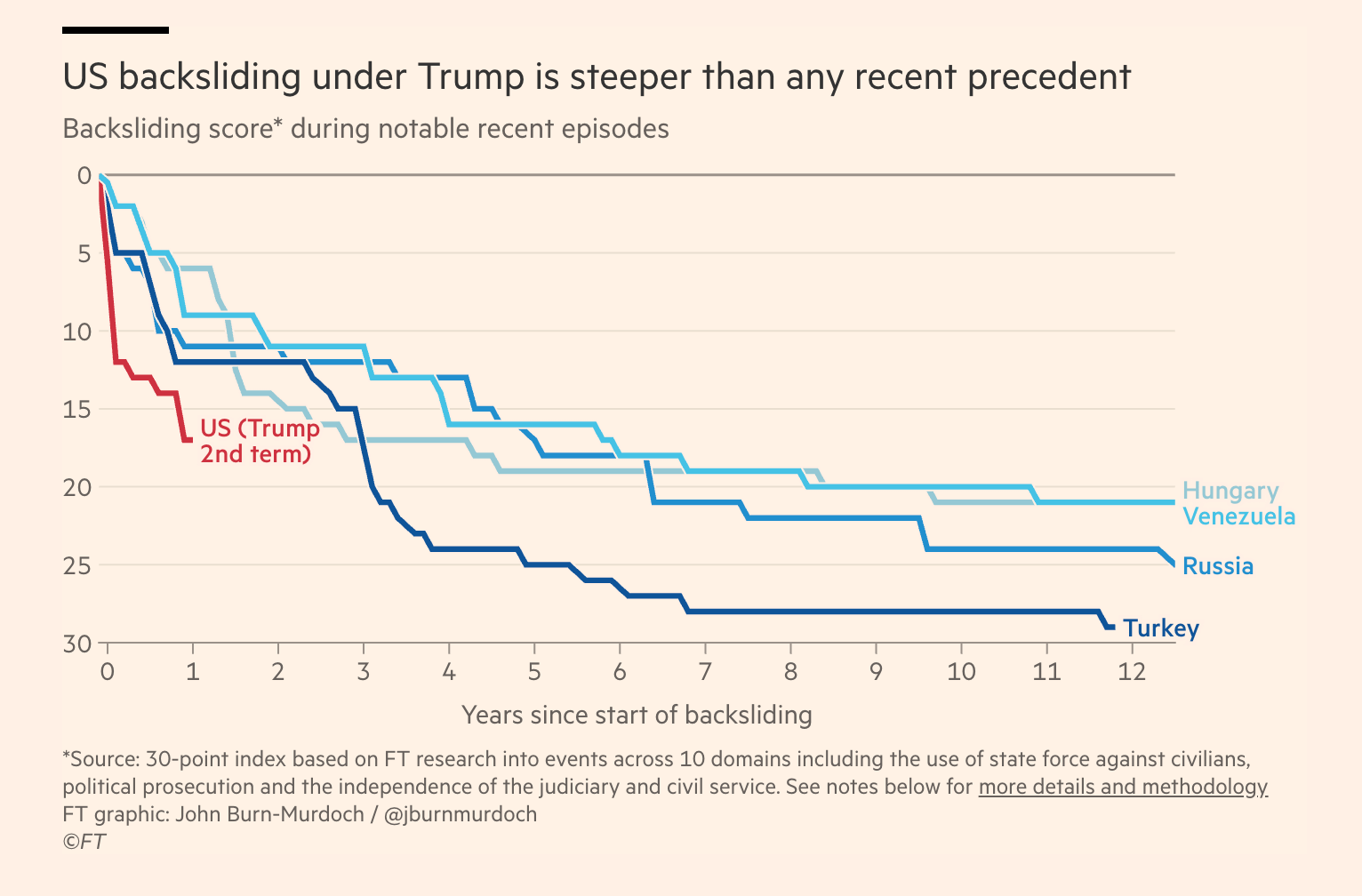
Measured using objective criteria spanning 10 domains including the use of state force against civilians, political prosecution and the independence of the judiciary and civil service, I find that the US slide during Trump’s second term stands out as the most rapid in contemporary history. It outpaces the early stages of backsliding under Russia’s Vladimir Putin, Turkey’s Recep Tayyip Erdoğan and Hungary’s Viktor Orbán, where similar steps unfolded over several years.
The comparative data are sobering. The visual below illustrates how the United States’ backsliding score compares to Hungary, Venezuela, Russia, and Turkey. What it shows is that leaders such as Hugo Chávez, Vladimir Putin, Recep Tayyip Erdoğan, and Viktor Orbán took much longer—many years longer—to reach levels of democratic erosion that the United States has experienced in just the first year of Trump’s second term.
The implications are deeply troubling, and there is no easy way to soften that conclusion.
If there is a potential bright spot, it lies in how this erosion has occurred. Much of Trump’s effort to undermine democratic norms has come through executive action rather than through the systematic capture of democratic institutions themselves. Burn-Murdoch emphasizes that this distinction matters.
And here, a difference emerges. In the cases of Russia, Turkey, Hungary and Venezuela, erosion came about through both channels. The likes of Putin, Erdoğan, Orbán and Hugo Chávez were able to consolidate power by exerting considerable control over the courts, media and electoral and political systems in addition to direct executive actions, locking in durably favourable conditions for themselves and hostile environments for their opponents. In Trump’s second term, by contrast, most of the action has taken the form of shocking acts or events that bypass rather than permanently corrupt institutions.
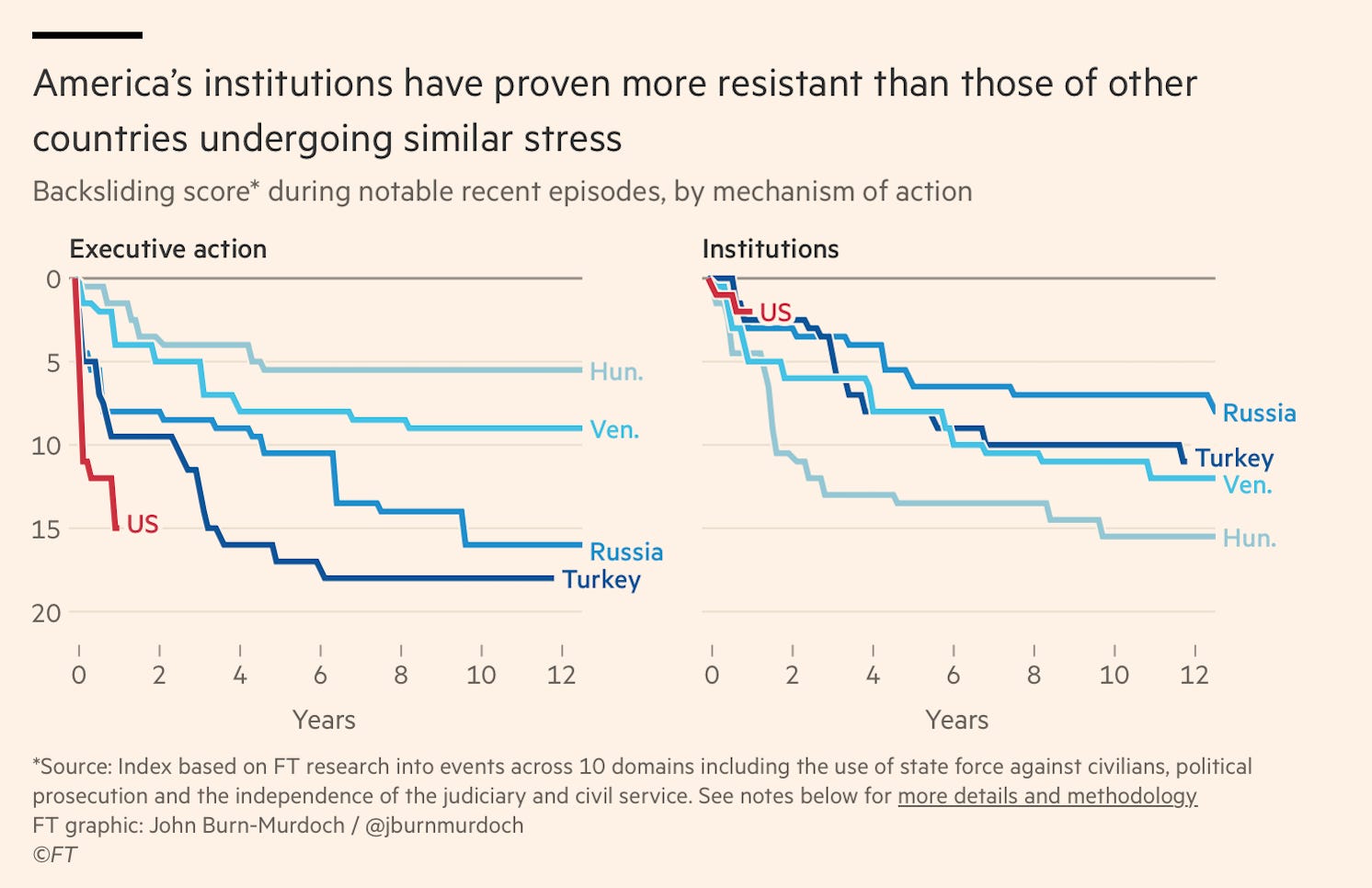
This should not be read as an absolution for Congress, the Supreme Court, or other democratic institutions. Many have failed to rise to the moment. Still, those institutions have thus far proven more resistant than their counterparts in places like Hungary or Venezuela—a difference that may yet prove consequential.
Speaking of Hungary…
In other troubling democratic news, Steven Levitsky—Harvard professor of government and co-author of How Democracies Die—recently offered a grim comparison between the Trump administration and Viktor Orbán’s Hungary in an interview with Status. Speaking in the aftermath of the arrests of journalists Don Lemon and Georgia Fort for reporting on protests in Minneapolis, Levitsky underscored just how alarming this development is.
“This is a new dimension,” Levitsky said in an interview. “In democracies, journalists don’t get arrested. In authoritarian regimes, journalists get arrested.”
Levitsky said the administration’s tactics are, in some respects, more overtly aggressive than those used by well-known strongman leaders abroad, going beyond that of Hungarian Prime Minister Viktor Orbán.
“Orbán doesn’t arrest journalists,” he said. “And in Hungary if you walk the streets of Budapest or other Hungarian cities, you will not find heavily armed masked men abducting people. That doesn’t happen in Hungary.”
That comparison should trouble us. When the United States begins to look worse than regimes long cited as cautionary tales, the question is no longer whether democratic backsliding is occurring. The question is how fast it is moving, and whether our institutions can still slow it down. Stay tuned…